Create and Manage Roles
Follow the procedures in this topic to add and manage roles through Portworx Backup web console.
The roles described in this topic apply to Classic mode only. Federated mode uses a different role model (for example, it does not include the application administrator role). For more information, see Role Privileges Matrix.
Super administrators and infrastructure administrators can add and manage roles. Only super administrators can add or delete users and user groups; infrastructure administrators can view and edit existing users and user groups but cannot create or delete them. For more information, see the Role Privileges Matrix.
Create roles
You can add a role with default permissions or assign specific permissions to a role to access Portworx Backup resources. By default, Portworx Backup displays the following pre-created roles:
px-backup-super.adminpx-backup-infra.adminpx-backup-app.adminpx-backup-app.user
The availability of built-in roles differs between Classic and Federated modes:
| Role | Classic mode | Federated mode |
|---|---|---|
px-backup-super.admin | Available | Available |
px-backup-infra.admin | Available | Available |
px-backup-app.admin | Available | Not available |
px-backup-app.user | Available | Available |
The following table summarizes the default permissions for each built-in role across Portworx Backup resources. For a detailed breakdown of Create / View / Edit / Delete operations per role, see the Role Privileges Matrix.
| Resource | Super Admin | Infra Admin | App Admin | App User |
|---|---|---|---|---|
| Cloud accounts (Classic mode only) | Full access | Full access | View only | View only |
| Backup locations | Full access | Full access | Full access | View only |
| Schedule policies | Full access | Full access | Full access | View only |
| Rules | Full access | Full access | Full access | View only |
| Roles | Full access | Full access | View only | View only |
| Users and User Groups | Full access | View and edit only | No access | No access |
You can leverage these built-in roles or create your own based on your organizational requirements.
To create a role:
-
On the home page, in the left navigation pane, click User Management.
-
In the User Management page, navigate to Roles tab and click Create Role.
-
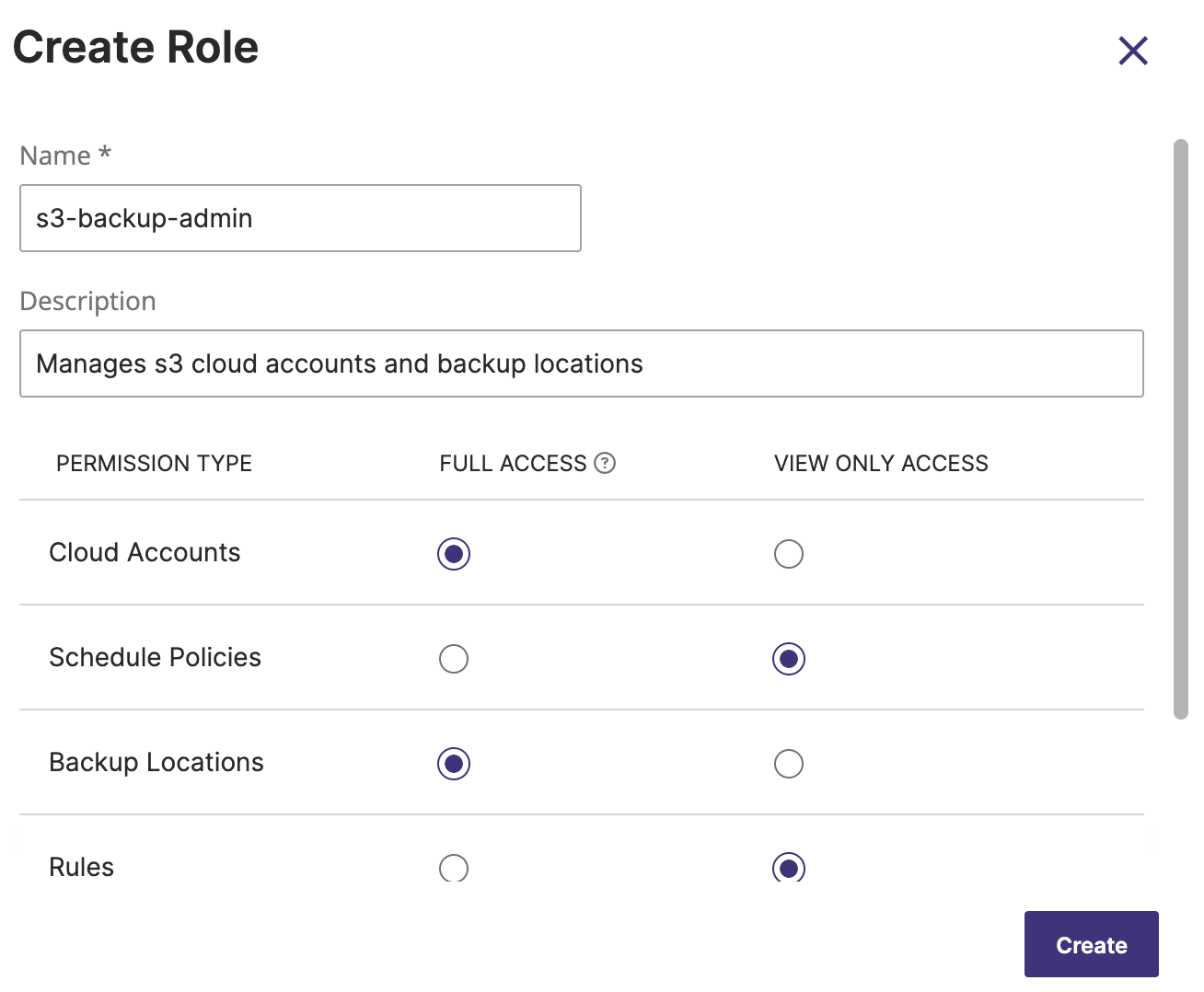
In the Create Role window, enter the following information:
-
Name: enter the name of a role in lower case. Ensure the role name:
-
is unique, lower case, and not less than three alphanumeric characters
-
starts and ends with an alphanumeric character
-
cannot include blank space
-
can include a period (
.) or hyphen (-) to separate words, but a separator is not required
For example,
appadmin,app.user, andbackup-operatorare valid role names, whereasApp Admin(contains uppercase letters and a space),ab(fewer than three characters), and.appuser(does not start with an alphanumeric character) are invalid. -
-
Description: enter a brief description about the role and available permissions to access Portworx Backup resources.
-
Choose either Full Access or View Only for the following Portworx Backup resources to assign the required level of access to the role you create:
- Cloud accounts (Classic mode only)
- Backup locations
- Schedule policies
- Volume resource only (VRO) policies
- Rules
- User roles
-
-
Click Create.
Portworx Backup displays the newly created role in the Roles tab in the order of creation.
Access permissions
Users with the admin role can access the following resources in the Portworx Backup web console:
- Can view and back up clusters that you added
- Can view all user-created backups on the Backups page
- Can view all Portworx Backup security objects such as cloud credentials, backup locations, schedule policies, and backup rules of all users
- Cannot view non-Portworx Backup user management objects
The access permissions available to a user in case of backup sync are:
- If a user is the owner of a bucket, then the Backups page lists backups of all users who used that bucket
- If a user is a collaborator, then the user can view own backups only
Filter roles and mapped roles
Portworx Backup enables you to filter the existing roles and mapped roles in the Roles page.
To filter roles and mapped roles in the Roles tab:
-
On the home page, in the left navigation pane, click User Management.
-
In the User Management page, navigate to Roles tab.
-
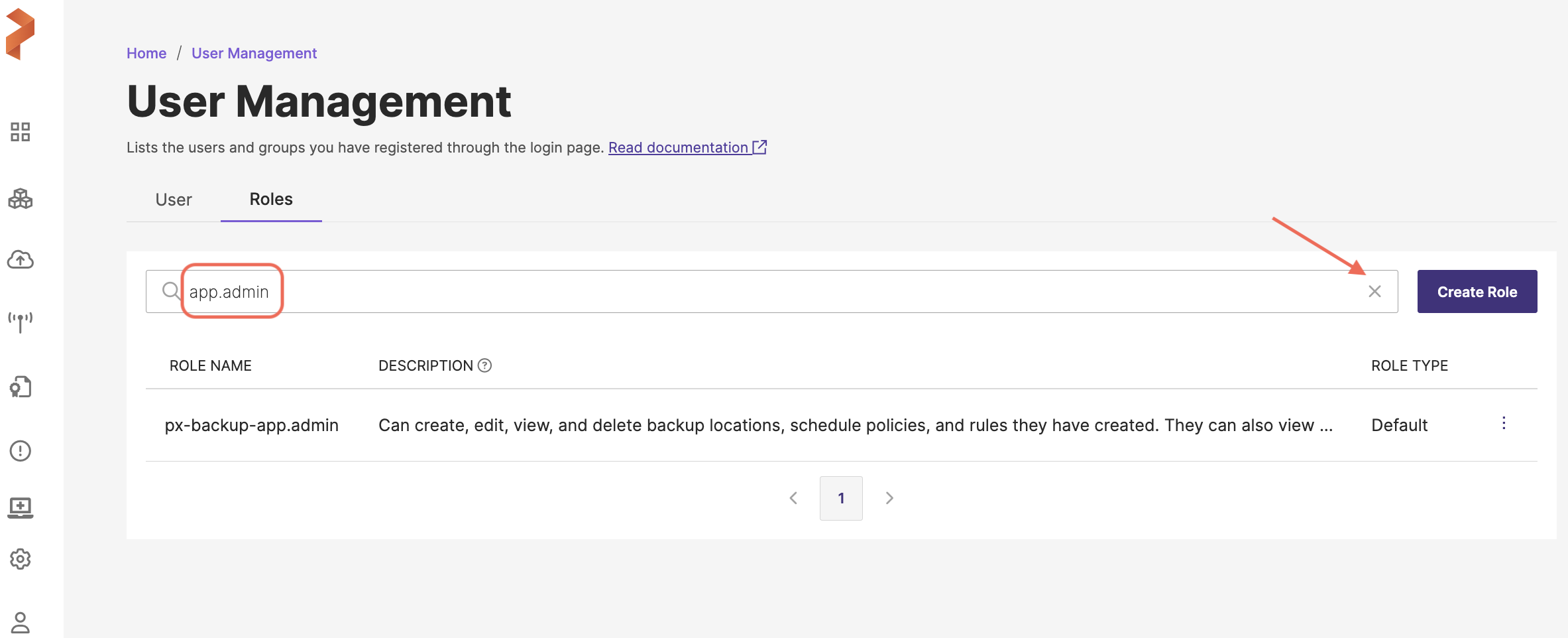
In the Filter... search box, enter any character in a role or mapped role.
-
Press Enter or click anywhere outside the Filter… search box.
The matching roles and mapped roles with the text you entered appear in the Roles tab of User Management.
-
To go back to the default Roles tab, click the x icon in the Filter… search box.
noteThe Filter… search box in the Roles tab of User Management page is case-sensitive.
View role details
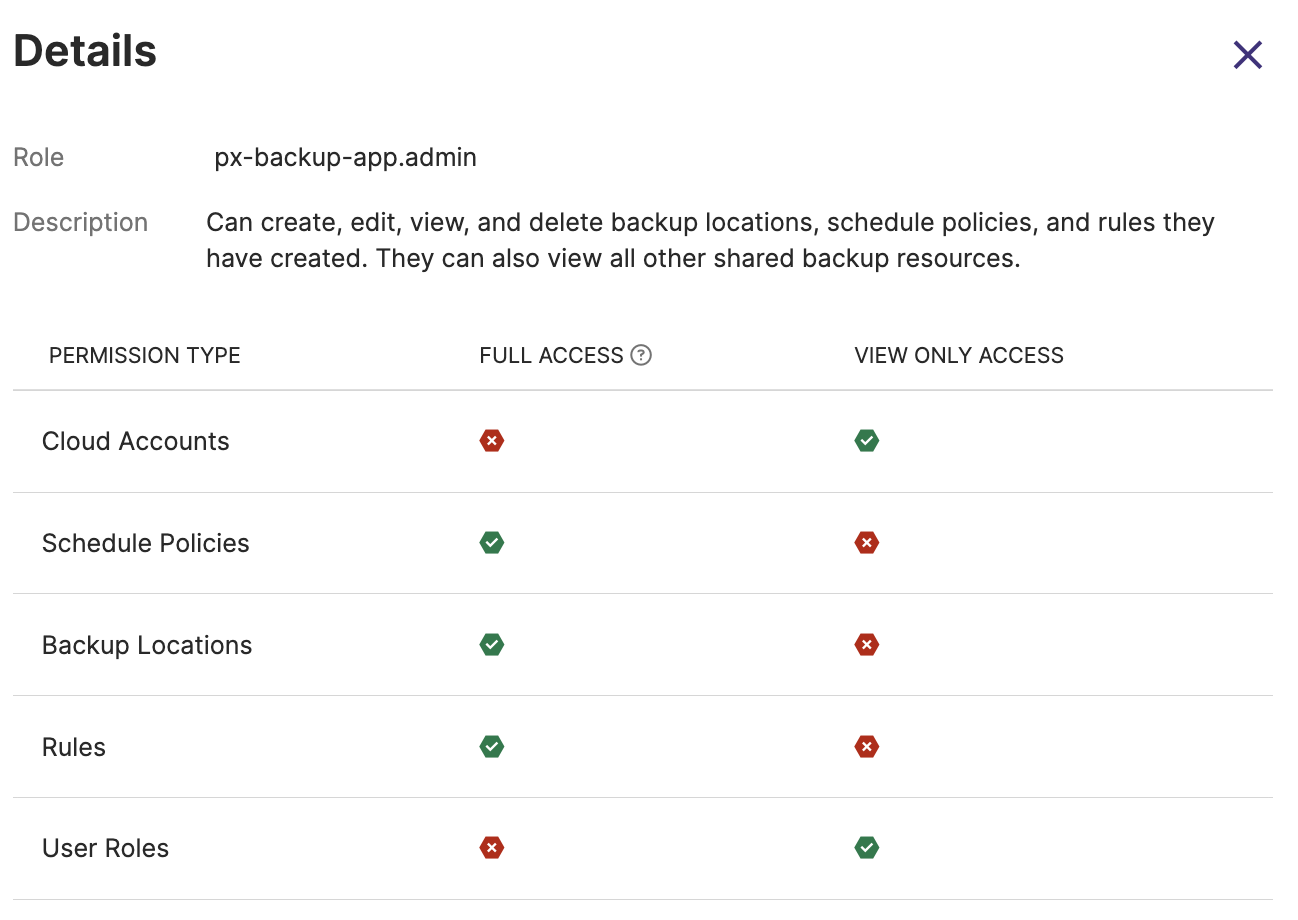
You can view the role name, description, and the permissions granted to any existing role.
To view role details:
-
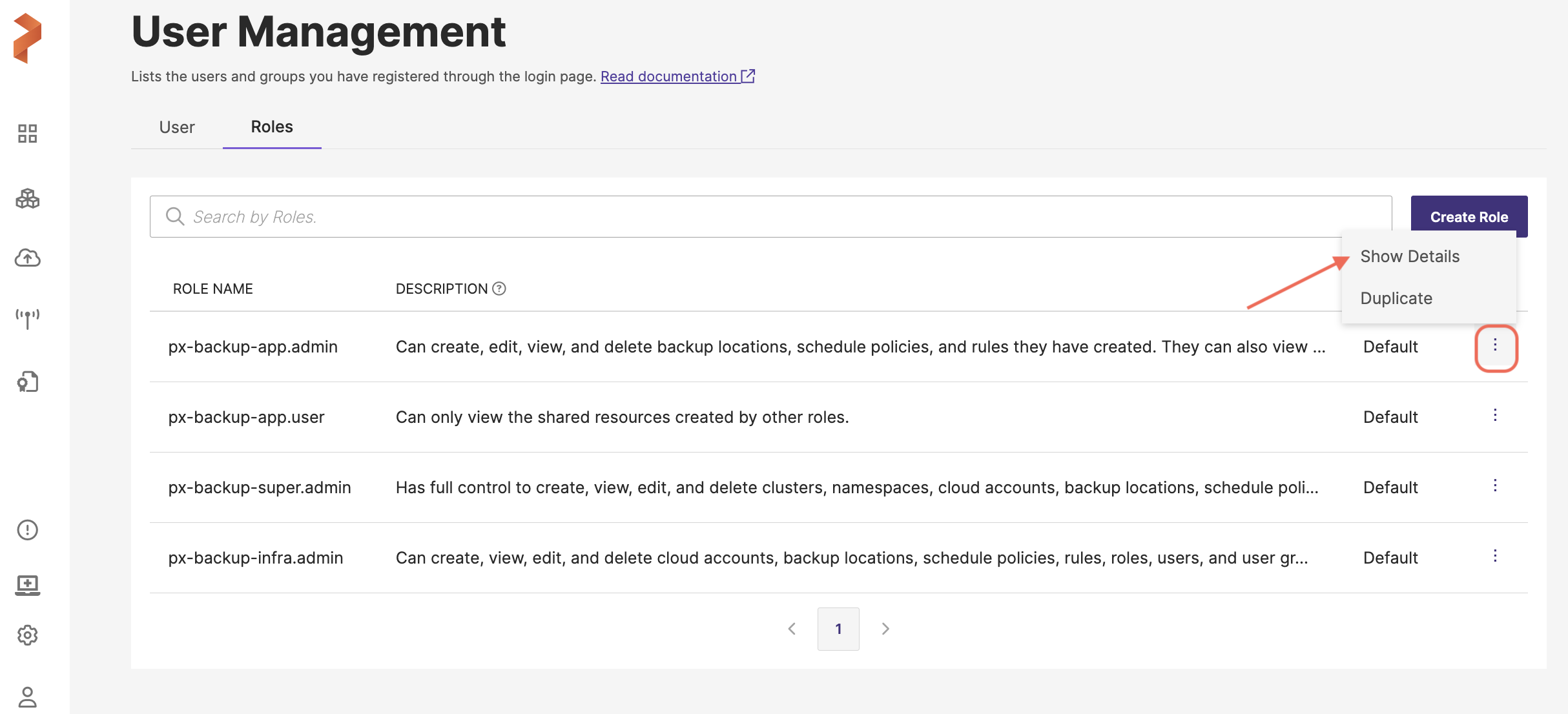
In the Roles tab of User Management, select the vertical ellipsis (at the end of the row) for the role you want to view the details.
-
Select Show Details.
The Role Details window displays role information.
Duplicate roles
Portworx Backup allows you to duplicate an existing role. Duplicating roles saves you time when creating multiple roles with similar permissions.
You cannot edit role permissions when duplicating a role.
To duplicate an existing role:
-
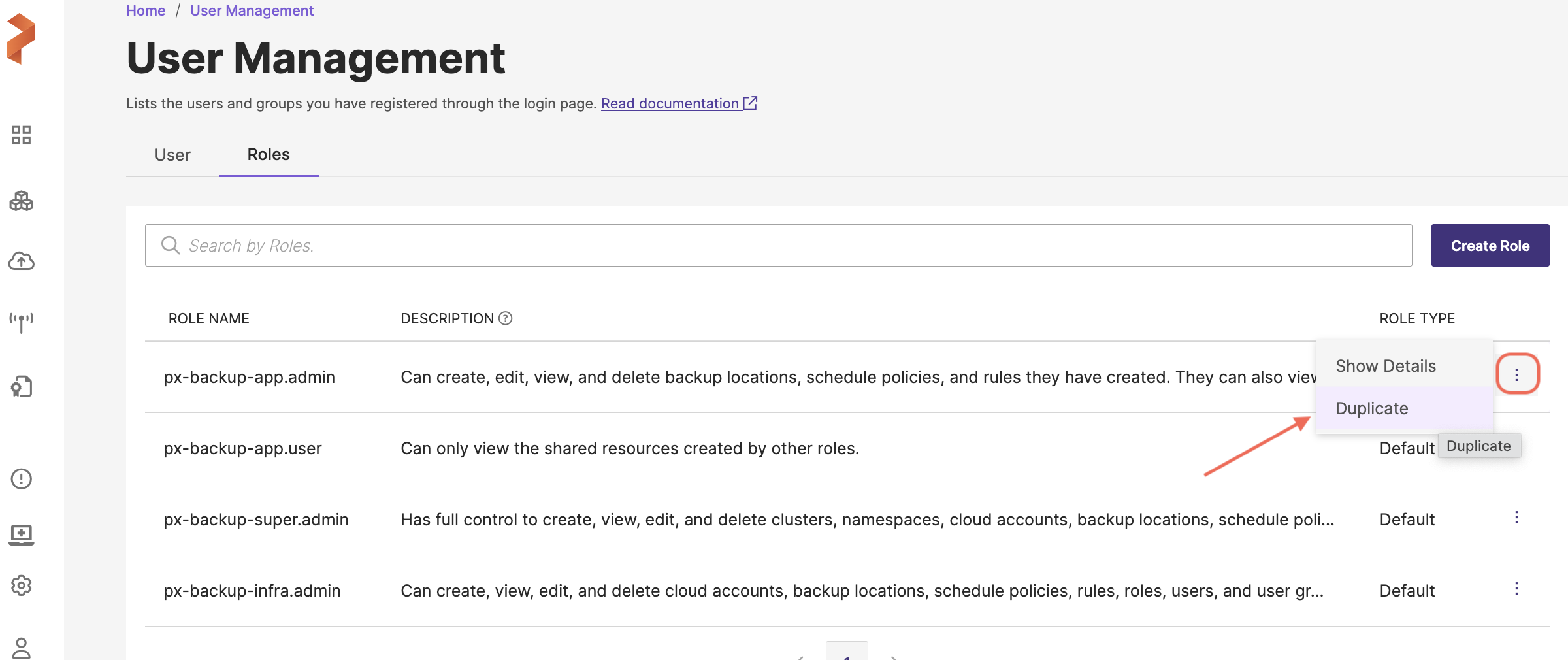
In the User Management > Roles tab, select the vertical ellipsis on the role you want to duplicate.
-
Select Duplicate.
The Duplicate Role window appears.
-
(Optional) Enter a new role name and role description if required.
-
Click Duplicate.
noteIf you do not change the role name, then Portworx Backup creates a duplicate role with this name:
duplicate-of-*duplicate-role-name*.
Edit a role
Built-in roles (px-backup-super.admin, px-backup-infra.admin, px-backup-app.admin, px-backup-app.user) cannot be edited. This procedure applies to custom roles only.
To edit a custom role:
-
In the User Management > Roles tab, select the vertical ellipsis on the role you want to edit.
-
Select Edit.
The Edit Role window appears.
-
Update the Name, Description, or resource permission settings as required.
-
Click Save.
Delete a role
Built-in roles cannot be deleted. This procedure applies to custom roles only.
To delete a custom role:
-
In the User Management > Roles tab, select the vertical ellipsis on the role you want to delete.
-
Select Delete.
-
In the confirmation dialog, click Delete to confirm.
The role is removed from Portworx Backup. Any users or groups previously assigned this role lose the associated permissions.